Day Three: Choose a character to Discuss/Defend
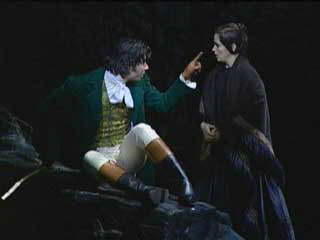
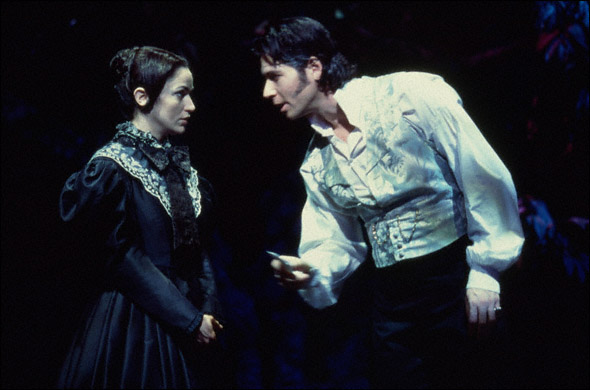
I have decided to do a Defense Post on Mr. Rochester.
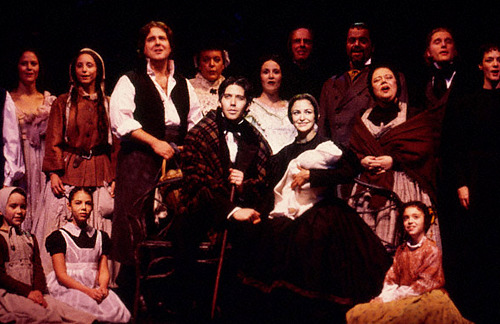
I really loved Mr. Rochester. I was surprised to hear what that a lot of Jane Eyre fans weren't very fond of the guy. I was like, "No but why? He is a sad little man!!" Since he is one of my favorite characters in Theatre, and yes, in literature too, I am going to do a post on him. The Musical follows the book almost exactly, so I'm going to use both as a reference in this post.
"Edward Fairfax Rochester! What's he like?"
Who is Mr. Rochester? He is the main male character in
Jane Eyre.
Why do people dislike/hate Mr. Rochester? (I list the reasons in the order I address them in.)
1.) He was abusive
2.) He was immoral.
3.) He was a jerk. (manipulative, spiteful, cruel...)
4.) He didn't care about anyone. He was selfish.
So here is a quick overview of Mr. Rochester's character. You don't learn much about his childhood. All you get from the book was that he grew up very wealthy and educated, and that his father was very stern, greedy, selfish sort of man. When he was about twenty years old, his father espoused him to a daughter from a very wealthy family. What neither the Father nor his older brother told him was that the girl was insane and wild.They tricked him into a marriage and suddenly Mr. Rochester was saddled with maniac who hated him.
He was married for about four years when he fled England and escaped his rather hellish life. While overseas he met and mingled with a few different girls, and there was one specific girl Celine Varens, who was more lovely than the rest. He fell in love with her. This woman, used him, cheated on him, and then left him. Some years later he discovered that the Celine had a child. She claimed the child, Adele, was his also, even though it bore no resemblance to him and really Adele could have been anyone's because Celine was
that kind of lady. Mr. Rochester took the child in anyway, as his ward. He was all she had. Celine had all but abandoned the poor child in the streets. Yeah. Nice lady.
She had this child Adele... said she was mine as well.
"Nothing lasts forever, Edward. Take good care and, oh yes,
Won't you take our lovely daughter?
For you see dear I don't want her."
After finding no happiness overseas either, he returned to England cynical, harsh, and very angry. He hated himself and almost everyone else and he was tired of the world.
Then, as he rode up the path to his House, he met Jane and everything changed.
Mr. Rochester was abusive.
No, he wasn't. People use the word "abusive" way too often. It is like the fall-back word. "Oh, I don't like that character. HE WAS ABUSIVE." Here is the actual definition of
abusive.
1.) extremely offensive and insulting; "abusive language"(Abusing; mistreating. Wrong, bad,excessive use of a person or object)
2.) engaging in or characterized by habitual violence and cruelty. (Coarse and insulting in language; scurrilous; harsh, scolding.)
*Source : New World Dictionary.
Edward Rochester wasn't abusive. He was cranky and rude, and he could be a big jerk sometimes, but he wasn't abusive. He treated all his servants well and paid them handsomely for their work. He made sure that Adele was always happy and well-kept and he would often bring her back gifts from abroad. He even tried to keep his mad wife as comfortable and happy as he could and he payed very good money to see that she had a nurse to look after her. He wasn't abusive, He was a twerp and he had a hot temper, but he wasn't abusive.
Mr. Rochester was immoral.
This is used in reference to how he treated his wife, the things he did while he was travelling, and the fact that he lied to Jane. This is an issue I'm going to spend the most time on because it is a huge part of Mr. Rochester's character and something he is judged very hard for. Let's start with his wife and the supposed 'marriage' he was in.
Bertha Mason was insane. She was completely mad and the worst thing was that both the families knew how bad she was. Rochester's father was an old acquaintance of Mr. Mason and the two parents set up an arranged marriage with between Rochester and Bertha. After the wedding both family's would benefit and the Rochester's would be very rich. They wanted the money, so Rochester's Father and older brother tricked him into a marriage with a lunatic before he knew what he was getting himself into. He was only twenty-two. He had never been alone with her and the few time he did see her they were at parties or dinners. They never spoke much. She was always dressed well and presented as some fine, great lady, so Mr. Rochester had a false idea of who she was. He never really loved her, he didn't even know her, but suddenly he was married and bound to her forever.
After the wedding both the families dropped Mr. Rochester like a hot potato. Bertha was his problem now and they would have nothing to do with her. They couldn't have her name soiling theirs and they couldn't be associated with a man who had such a horrid wife. Mr. Rochester couldn't go about in society because people mixed his name with his wife's and he got a bad reputation from it. He lost a lot of friends because of Bertha. Everyone was afraid of her and the fact that Rochester was married to a women like that sort of freaked everyone out. Even still, Rochester tried to be generous and good with Bertha. He tried to tolerate her and suffer through the judgement of society and the alienation from his family and friends. He fought it out for over four years and by then he was drawn to his limit. He couldn't take it anymore.
He couldn't sleep. He had nightmares about her. She would scream all night, and most of her screams were curses and threats directed at him. She hated him and she would attack him on sight. He was alone, isolated and miserable. By the end of those first four years, he was traumatized and desperate.
He nearly killed himself. The only reason he didn't was because as he held the gun, he realized that there was another way. He could seek out friendlier shores. He would take his wife to the Mansion, Thornfield, and hire a nurse to look after her so that she would be well taken care of. He would leave England and start over again.
Mr. Rochster did a lot of travelling after this and he lived the life. He courted. dated. He made new friends and he made companions of many girls. From what I can tell, I think he had a couple of little
flings with some of them. It sounds like there were about three, if you count Celine. This was over the course of about ten years.
Was this wrong? Yes, it was
very wrong. But... that is kind of the point. You aren't supposed to think Mr. Rochester was in the right. The story is meant to show that good men who get hit too many times can do bad things. Mr. Rochester was emotionally devastated and he honestly didn't consider himself married man. He got weak. He fell. (I think in this case the marriage wasn't actually valid. If you're forced, pressured or tricked into a marriage then it isn't valid in the eyes of the Church. You both have to know exactly what you are agreeing to and consent to it with all your heart and will.)
After the catastrophe with Celine, Mr. Rochester finally gave up on love altogether and returned home to Thornfield.
That is when he met Jane, the governess of his young ward Adele. He'd been travelling for about ten years so he was like... thirty-five or thirty-six.
"She found me handsome, my Opera Dancer
and like a fool I believed it was true..."
Here's the thing. Mr. Rochester did not want to fall in love with Jane. He tried his very hardest not to. He tried to be cold and withdrawn, to keep her at an arms length and silence his emotions. But Jane intrigued him. She was a shocking little spitfire with a calm, reserved mask. She didn't let him get away with much and if he was rude or sharp she would put him in his place. She made him laugh. She made him
happy.
He never told told Jane about the mad wife he had locked up. With Grace in her room, Bertha was usually quiet. If she did have a bad night she was quickly silenced and in the morning Edward would explain the screams by saying that the a servant had a nightmare. Usually the servant who took the fall for this was Grace herself. He kept Bertha a secret and courted Jane. He got engaged to Jane and still kept the secret. He didn't want to lose her.
Was it wrong to keep Bertha a secret? Yes. Should he have told Jane the truth? Yes. Did he? No. Does that make him a horrible immoral person?
No.
You have to remember that Rochester didn't consider Bertha his wife because of the circumstances that the marriage had taken place under. He told himself it was okay to date Jane. He knew she would see it differently and he didn't want to risk that.
"I was wrong when I deceived you, but there was not other way.
Your character wont let you live the life I must obey."
Mr. Rochester was a Jerk.
People think Mr. Rochester was cruel because he locked his wife up in Thornfield and kept her in a room upstairs, isolated from the world. I think they are not seeing the whole picture. Bertha was a menace to herself and everyone around her. She tried to kill people. She tried to harm herself. She even attacked her brother on the very rare occasions when he visited. Once she bit his neck and almost killed him. The girl couldn't be loose to do as she pleased. It wasn't like Mr. Rochester just left her up there to rot either. He got a nurse, Grace, who spent the day caring for her. He would go up and check on her sometimes, just to make sure she was being treated well. And he was always very good with Bertha. He never hit her or yelled at her. Even when she attacked him he never fought back. He never hurt her. He would wait until Grace could grab her and pull her back.
Honestly, he could have done a lot worse. He could have thrown Bertha into an asylum and been done with her, But he couldn't find it in his heart to do that. He was afraid she would be mistreated and that life in the asylum would kill her. So he kept her with him and did everything he could to make she she was okay. That isn't a cruel man. That was very kind and even merciful.
I will say, for most of the book Mr. Rochester wasn't very kind to Adele. She looked exactly like her mother and seeing her brought back a lot of painful memories. It was that much worse because he didn't think she was his child at all. He was very stern, even cold with Adele, and didn't have much patience with her. But he didn't mistreat her either. He got her the best of everything, even supplied her with a governess, and often brought little gifts to make her happy. Sometimes when he spoke to Jane he would call Adele a brat* silly, idiotic or dim, but he didn't do it too often. Mostly he just kept quiet about Adele altogether. And he did get better toward her as the story went on.
*Note; he only called Adele a brat a couple of times, and I think it was actually the older definition of the word, which is basically just 'child.' He said it in that context too, so I don't think he meant Adele was a bad kid, just an annoying one. (Brat: Noun, derogatory, humorous. A child. Typically a bad behaved one. longer definition HERE)
"She is the Image of her mother, Miss Eyre.
A breaker of hearts in training."
At the beginning of the book, Rochester was very short with Jane. He didn't trust woman, he thought they were all liars and manipulators, so he was on his guard. He picked at Jane and he was flippant, as if daring her to
just try him. But Jane didn't let him get away with his attitude and usually she said one sentence that put him off his high horse. She was unlike anyone he'd ever met and he appreciated her honesty and bold answers. I think most of the reason he fell in love with her was because she never tried to put on airs or sugarcoat anything. She would tell things how they were and it was good for him to have someone like that, someone who wasn't afraid to stand up to him.
As for the other points of this topic: Mr. Rochester was a little manipulative. (I mean, he tricked Jane into thinking he was going to marry a wealthy, beautiful, lady just for the sake of getting her jealous. That's one example....) He also could be a little spiteful, especially at the beginning of the book. His language was rough, his temper was quick and sparked suddenly. The guy had issues. But he wasn't a bad guy. He was cranky, he was angry, he wasn't bad. He certainly wasn't evil.
Jane was Rochester's redemption. He needed a reason to believe in goodness again, and he needed someone who could see good in him when he couldn't even see it in himself. She gave him hope. For the first time in his life, someone actually cared about
him, not just his money or his title. She made him think that maybe not all was lost. Maybe he could change. Maybe God was, in fact, good.
"Her spring of life draws me near
Her gentle voice I hold dear
Her life has infected every wound and every pore
I feel her mystery possess me....
And I pray that mercy's hand will bless me!"
So yes, when the story begins Mr. Rochester is angry and harsh, but he doesn't stay that way. He changes. He gets
better. Jane makes him better. It takes a while, but after a few months of Jane being there, Mr. Rochester starts to be kinder. He starts to soften a little. Is he a jerk sometimes? Of course! But when he brings down his walls, he is so sweet with Jane. You can just tell he has a big heart and he can love so much, if only someone would love him... It's adorable.
This is a story about Conversion and Redemption. It is meant to show how men (and women.) can falter and sin, but no one really has the right to judge another person's soul. You can say that Rochester's
actions were wrong. (No arguing that. He did some hanky stuff) But in justice, you have to take in the whole situation and not just his mistakes.
When Jane discovered Bertha, Mr. Rochester took the time to sit alone with her and just explain. He was so young and so desperate...
He knew it was wrong to lie, but he couldn't bear to lose her. He confessed how careless he had been when he was younger, and the different girls he stayed with. He told her he hated himself for those years and he regretted them with all his heart. He called himself a brute and he told her that he was entirely in the wrong. He asked Jane to forgive him.
Mr. Rochester lost his way. He is just a man, and men make mistakes. He wasn't evil, he was weak, and he hated himself for that. He was sorry for his past. People can
change. People can be redeemed. Mr. Rochester wanted that, he
wanted redemption. If he hadn't had any remorse, then he wouldn't be worthy of forgiveness, but he had nothing but remorse. In his heart, he wasn't an evil man. He was a flawed man who wanted to be better.
"Jane - it would not be wicked to forgive me."
When Mr. Rochester found Jane gone the morning after their wedding day, he fell apart. He couldn't believe that God could be so cruel as to give him Jane and then rip her away. He was angry with Jane, angry with himself and very angry with God. He went wild with grief and he started venting and cursing and throwing a giant tantrum.
"God should strike me down if you are truly gone
But why must I have eyes to see you're not there?
Why must I take one more breath? Let lightning strike,
that's not the worst! I'd rather burn in hell,
damning my soul as well, lost in my pain!
Then to live here on earth without my Jane!"
That is pretty low, right? Mr. Rochester hit rock bottom and somehow got lower. It's easy to wonder how someone can come back from a (prayer?) like that. This is when I talk about Mr. Rochester's character ark.
After Jane left, Bertha somehow escaped from her room and started a fire in Thornfield. This is when you see the who Mr. Rochester really is - you see his true colors.
He wouldn't leave the house until he was sure everyone else was out. He carried Adele from the fire in his arms. He helped all the servants escape, going so far as to hold them and drag them to safety, Finally, he went up to Bertha's room and tried to save her also. She was standing at the window and he climbed up, calling her name, telling her to come down. Bertha was like "NO I HATE YOU!" And she jumped out the window to her death. There was nothing else to be done, and only then did Mr. Rochester try to get to safety. But he was too late. Before he could get out, the house fell down on top of him. He was crippled, blinded and left helpless.
"Thornfield was burning, we all would have died,
had not Mr. Rochester gone back inside....
Edward saved everyone else who was there,
But got out too late for himself...."
Let me ask you a thing. If Mr. Rochester was evil, cruel, or selfish, why would he risk his life to make sure everyone was safe? This act of bravery wasn't spur of the moment. It wasn't like he helped one person get away and then lost nerve. He literally stayed in the house as it burned down around him, running into different rooms and pulling servants out of the fire, getting them to the door and then running back to help the others. He went up to the attic and tried to save his
wife, the wife who hated him, the wife who had made his life a living hell. He wouldn't leave her alone, he even tried to pull her out of the window. He did everything he could to save Bertha. That is not an evil man!
"The secret of the flame
Is that there is no more to hide
It cures our blindness and our pride..."
That fire was the a major part of Mr. Rochester's redemption. It showed that when it mattered, when it was life and death, the side of him that won out was the side of courage and honor and kindness. And that was his real turning point. His honor in that crisis brought back his better side. And after the accident he continued to be better. He resigned himself to the fact that he would never be happy. He accepted the suffering as penance for his sins. He acknowledged that he had done a lot of wrong and this was the price he had to pay. He repented and turned to God for forgiveness and reconciliation.
"...I began to see and acknowledge the hand of God in my doom.
I began to experience remorse, repentance; the wish for reconcilement to my Maker.
I began sometimes to pray: very brief prayers they were, but very sincere."
Jane returned to Thornfield the next year. God gave her a sign and she knew she had to go back and check on Mr. Rochester. She finds him blind and crippled and learns what happened that night after she left. The past few months have left Mr. Rochester very changed and humbled. He doesn't think he deserves Jane's love, let alone her hand in marriage.
"I am no better than the old chestnut,
struck down by lightning, it's life cleft in two
For why should you marry a blind man, a cripple?
Tell me Jane, what right do I have to you?"
Edward Rochster was very flawed. He made a lot of mistakes and he did a lot of wrong, but in the end his heart won through and he found redemption. He risked his life to save others and when he was crippled, he blamed no one but himself. He made his peace with suffering and slowly, slowly, he gave his soul entirely to God. It was only after all of this that God allowed Jane to return to him. Mr. Rochester had asked that he might be taken from this world soon, but instead God gave him a second chance with his life. He was able to marry Jane after all, and two years into the marriage, the sight in one of his eyes returned to him. He was blessed to see his first child and all the children after that, and for all this he thanked God. He never stopped thanking God.
"I will never lose faith, I will never lose heart
For you have restored my trust..."
At the end of the musical, (and the book) Mr. Rochester is not the same harsh man he was when Jane first met him. He has grown gentle. He loves Adele like she's his own. He takes care of his servants like they are family. He is softer, kinder, more patient and generous. He can still be a brat, but he is a good man, and I think that is the only thing that really matters.
Have you read Jane Eyre? Have you heard the musical? Do you like Jane? What do you think of Mr. Rochester? (It's OK if you don't like him. We just won't go there.)
Peace out y'all!!!
*swings around capes and jumps off stage*
Bella